

I participated in a Ph.D. course “Global Urbanism” at Stockholm University in Sweden during 2018 April 23 and 27. The course was formed and hosted jointly by Lund University in Sweden. As the course title implies, the course focused very much on modern “critical” urban theories such as postcolonial urban theory, different versions of assemblage theory, a strand of theories standing upon planetary urbanism assumption. These theories were discussed in relation especially to the context of global urban policy transfer (e.g., massive commercial-urban development, transport development, sustainable city development). In addition to the great thinkers from the host universities, two prominent researchers of the field, Dr. Kevin Ward and Dr. Jennifer Robinson, took part in the course as guest lectures, which was a really great opportunity for me to learn the topics from the front-line researchers. Although my PhD project depends heavily on quantitative analyses, having an overview of modern urban theories is helpful to conceptualize phenomena of interest; to build qualitative models; and to analyze causalities of the model results. All participating students were supposed to write and present a paper draft relevant to the course topics. I presented my paper draft, which will hopefully be a peer-reviewed journal article, about transit oriented development (TOD) in the context of global urban solution transfer. The composition of my fellow students of the course was pretty international. My coworkers provided wider and different views regarding the course topics based on their diverse background – that were very mind-provoking.
In relation to the course topics, we went to Rinkeby, a town district in Stockholm, one of the “immigrants” towns. Nearly 90 % of its citizens have a foreign background. Even though Rinkeby has been confronting socio-economic challenges/segregation, so do other immigrants towns, what I observed in the town were efforts to make the town better.
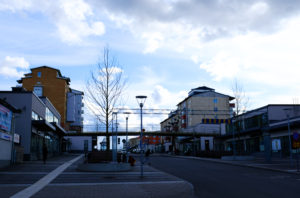
Built-environment wise, there were various new constructions to upgrade the town’s architectures. According to one of the professors, “covering-up” a motor way (E18) by an artificial ground is one of the important physical modification to get rid of a barrier to Kista, the silicon valley in Sweden, which is situated just next to Rinkeby used to be geographically separated by route E18.

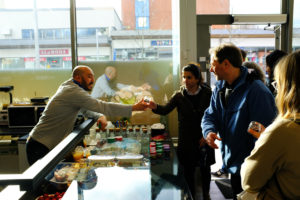
Community wise, I could feel that people living there try to form a solid sense of community. We dropped by a lively cafe close to the Rinkeby station. It was a quick observation though, the store manager seems to have a keen commitment to the community activities, and the cafe can function as a place for the locals to mingle out. Despite the challenges Rinkeby faces, I felt that people’s efforts to make “life” in the town could make a better future of the town.
Overall, I am satisfied by the course very much, and learnt a lot of new things. You can see detailed information (version 2018) about the course here. I am not sure whether the course will open next year, but I certainly recommend this course if you are a PhD candidate studying / interested in modern critical urban theories!
Suggested readings: