
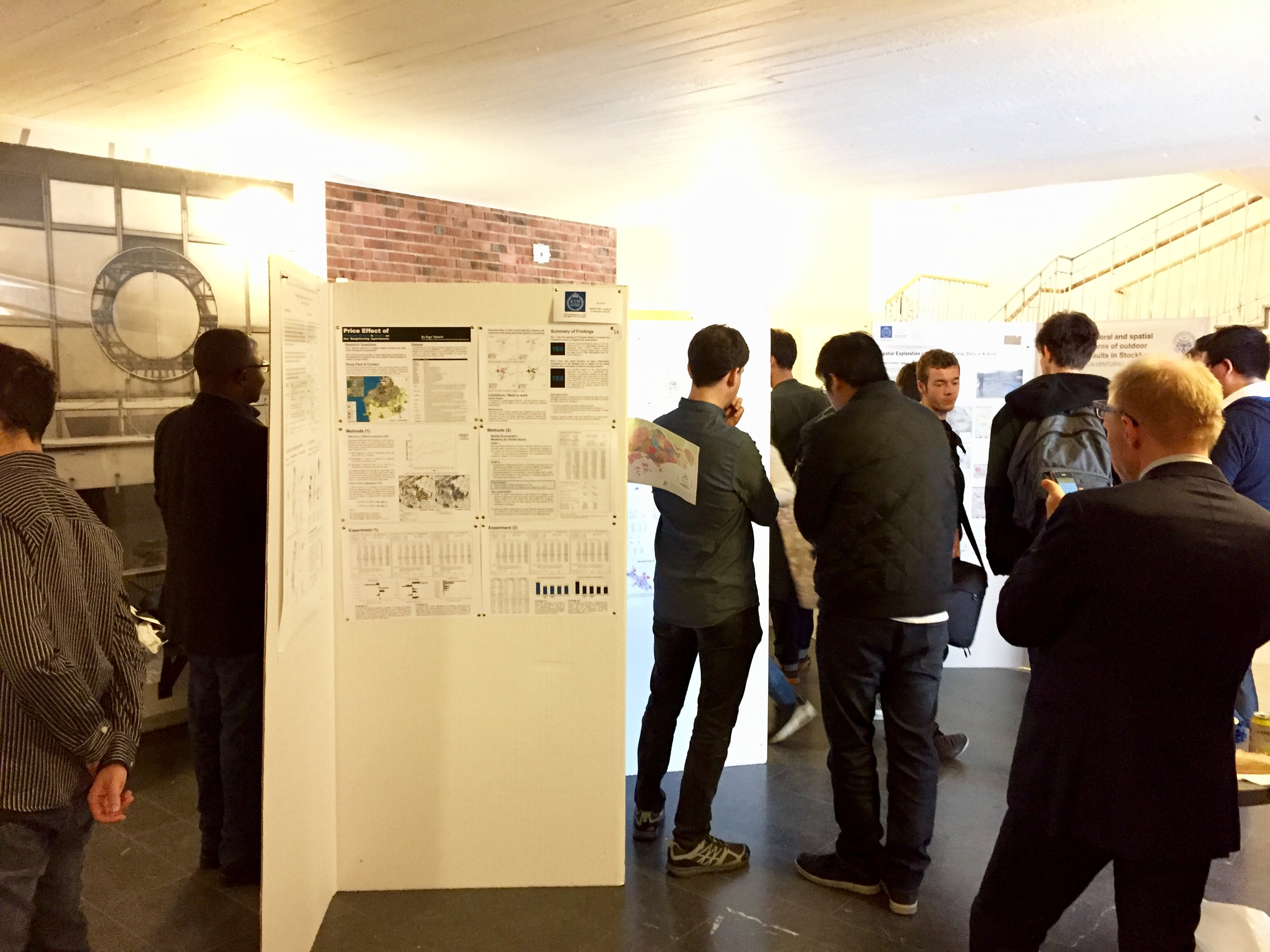
As a Ph.D. candidate, I have been taking a PhD course “Spatial Data Analysis in Practice (7.5 Credits)” at KTH (Royal Institute of Technology in Sweden). Today is the day for a poster presentation of our final projects. I displayed my poster about a potential sales price premium of Triangeln, a new commuter train station in the City of Malmö in Sweden, for the neighboring apartments.
My project consists of two research questions:
(1) Has Triangeln opening up increased the sales price of apartments within 1000-m walking distance from the station?
(2) Do XY coordinates of the dataset, that are based on street-entrance registers and thus do not reflect the actual location of the apartments, effect regression estimates?

To answer to these two research questions, together with the manipulation of XY coordinates (Point Location Adjustment:PLA), several spatial-lag regression models with DID (Difference in Difference) method and HAC (Heteroskedastic Autocorrelation Consistent) method were performed by GeoDa Space that is being developed by Dr. Luc Anselin. Regression results display that the opening up of Triangeln station has increased the sales price level of the neighboring apartments, and the original XY coordinates are prone to overestimate the regression coefficients compared to those with the PLA even after spatial autocorrelation and heteroskedasticity in the regression residuals were accounted.
My coworkers and I plan to submit a paper explaining methods and displaying details of the findings in a scientific peer-reviewed journal in the near future.